Structogram makes living together easier.
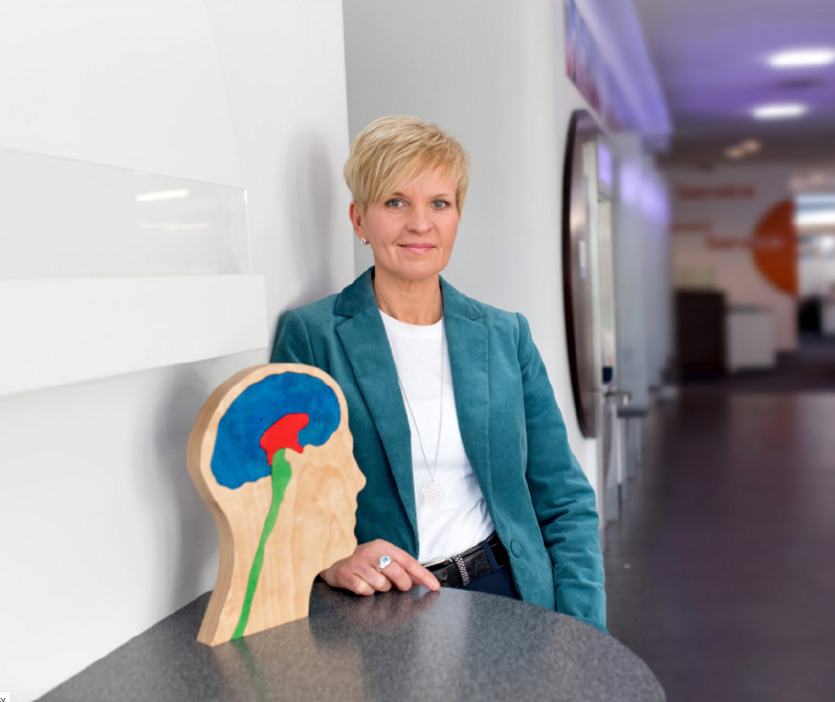
'If we, as two cooperative banks, are to merge to form VR Bank Oldeburg Land AG whilst maintaining our different mission statements and management approaches, then we need Structogram and Triogram training as one piece of the jigsaw in the bigger picture,' says Anja Marowsky, explaining her recommendation to the bank’s board and head of human resources. More than a year has passed since then.
Anja Marowsky is a lively, open-minded woman in her early 50s. Even as a child, she says, she was seen as inquisitive, lively and creative. She grew up in an entrepreneurial family alongside her two brothers. Her parents instilled values in their children: politeness and respect for others were just as much a part of this as the desire to create and make a difference.
In the mid-1980s, she “stumbled into” a banking apprenticeship, says the now-trainer. At the time, such training was seen as the start of a successful career. Looking back, Anja Marowsky admits, “I could have imagined something a bit more creative, but that’s not how people thought back then”. However, she went on to combine her creativity with the entrepreneurial spirit she’d inherited from her parents in her subsequent career.
After four years at Volksbank Visbek eG, she moved to Commerzbank in Bremen, where she received support and further training, and began a training programme as a trainer after five years as a customer adviser. She worked as a coach, supporting colleagues in the workplace and expanding her remit to include communication and public relations.
Towards the end of the 1990s, she had two children. Time for her family in Wildeshausen and her job in Bremen became very limited, and another move was on the cards. Frank Ostertag, the chairman of Volksbank Wildeshauser Geest eG, asked Anja Marowsky if she would like to join him as a trainer and public relations specialist. Another decade passed before two cooperative banks in the Oldenburg region finally merged into one, and Anja Marowsky successfully proposed incorporating Structogram and Triogram training into the bank’s in-house training programme, following her own additional qualification.
Anja Marowsky first came across the Structogram training at the cooperative banks’ training centre in Rastede around 2010, and she was very enthusiastic about the fact that there is a relatively simple analysis which, by answering a few questions, allows you to learn a great deal about yourself: “What I read about myself in the interpretation and description after answering the questions largely applied to me.” Anja Marowsky is predominantly green-red.
She is open-minded and approachable. But thanks to Structogram, she also knows where her limitations lie: “If I burst into the office in a dynamic, active manner to see a colleague with a predominantly blue component and surprise him with a suggestion, he might feel taken by surprise, as he likes to plan his appointments and prepare for them.”
Even ten years after her own Biostruktur analysis, Anja Marowsky still can’t help but smile during training sessions when participants have answered the questions, leaf through the book and read the description of their personality.
“It’s like being caught out – reading such an accurate description of yourself. And suddenly it all becomes clear to everyone: why do I get on so well with this person, and why do I keep running into problems with that one?” says the trainer: “Living together becomes easier, because I also realise that the person I keep having problems with doesn’t mean any harm. They’re just different.”
In a training session with around ten participants, Anja Marowsky forms working groups and asks them to discuss the strengths and weaknesses arising from the dominance of the various components in their personality structure.
People with a strong blue component like to plan their projects; they organise things and prepare thoroughly. They crave independence, are forward-looking and visionary. But if such a person overplays their own strengths, they come across to others as aloof and cold, are seen as a withdrawn loner and may even appear arrogant.
People with a strong red component live in the present; they possess natural authority, are dynamic, want to drive things forward, improvise, make quick decisions and inspire others. But they also run the risk of coming across as chaotic and hot-tempered to others. They tend to ‘run roughshod’ over others.
People with a dominant green component are sociable and usually well-liked. They are imaginative and tactful in their dealings with others. However, if they overdo it, they come across as out of touch with reality. They want to have a say in everything, drive others up the wall by repeating everything that has already been said, live in the past and are often regarded as hostile to innovation.
“We discuss these kinds of things in training,” says Anja Marowsky. Once all colleagues have familiarised themselves with the Structogram, the Triogram training follows. After all, once I’ve gained an understanding of myself, it’s also easier to work out the personality structure of the person I’m dealing with.
“I can apply this knowledge anywhere to better understand others when interacting with people, to treat them fairly and to achieve better results together,” says the trainer, whether when putting teams together or when dealing with customers. “What I offer with the Structogram and Triogram is help for self-help, to better recognise and understand myself and other people.”
The Structogram training has so far proved its worth on the path to a successful merger of the two formerly independent banks: “The training is just a small contribution to the success of the merger. A merger like this takes time, because it is more than just a technical change process. We’re on this journey with all its twists and turns, its highs and lows. I think it’s great that I’m able to contribute my knowledge and skills to this process. I ask the managers: ‘How have you structured your team?’ And the people at the bank are talking about my training. It’s a topic of conversation over meals. That’s a good first sign that it’s having an impact.”
“What I offer with Structogram and Triogram is help for people to help themselves—to better recognize and understand themselves and others.”

The Structogram, as the visualised result of the biostructure analysis, reveals the fundamental structure of one’s own personality (biostructure). From this, strengths, weaknesses, opportunities and limitations are identified. The aim is to develop in harmony with nature and to be authentic.
In the next step, participants learn to recognise other people’s biostructures. They become more attuned to their behaviour, are better able to understand the other person’s individuality, respond appropriately and avoid conflicts.
The biostructure analysis is a non-judgemental method for identifying innate personality patterns.

